The foundation every AI system you add later runs on. Built in plain files, inside your own accounts
We will build the AI operating system inside your business, so your team stops re-explaining the company to AI and starts getting back work that sounds like you.
One place your business is written down that your team and your AI both work from, and one to three real jobs running on it by the end.
- ✕Without another subscription nobody opens
- ✕Without handing your business to a platform you rent forever
- ✕Without a wiki that goes stale in three weeks
- ✕While owning every file we write
Do not keep reading unless your team already uses AI most days and the output still needs heavy editing. If nobody uses AI yet, this is early, and I will tell you so.
What results look like
The last one went live in fourteen days.
14 days
from first call to a working system
340
skills in the library, four custom-built for that business
14 → 85
workspace health score, out of 100
Thirty commits from two people writing into the same workspace, including a real merge conflict on a definition, which is the proof it was genuinely shared and not a backup folder.
Build facts from one engagement, not revenue claims. That client is not named yet. I would rather show you what was built than quote a number I cannot stand behind.

Why most AI spending fails
Ninety-five percent of AI pilots produce nothing. The reason is not the model.
95%
of enterprise GenAI pilots showed no measurable profit impact. MIT Project NANDA, 2025
9.3 hrs
a week per employee spent searching for and gathering information. McKinsey
2026
the year Gartner named context engineering the breakout AI capability
MIT studied enterprise AI in 2025 against thirty to forty billion dollars of spending. Their explanation for the failure rate was not model quality. It was a learning gap: the tools never learn the business or adapt to how it works.
Gartner describes the fix as context engineering, giving AI the situational awareness to act with relevance and precision. The industry finally has a name for the gap.
The point underneath all of it: everyone has the same models. The only difference left is what your model knows about your business.
The MIT figure is widely reported and also widely argued about. Treat it as the shape of the problem, not a law of physics.
The system
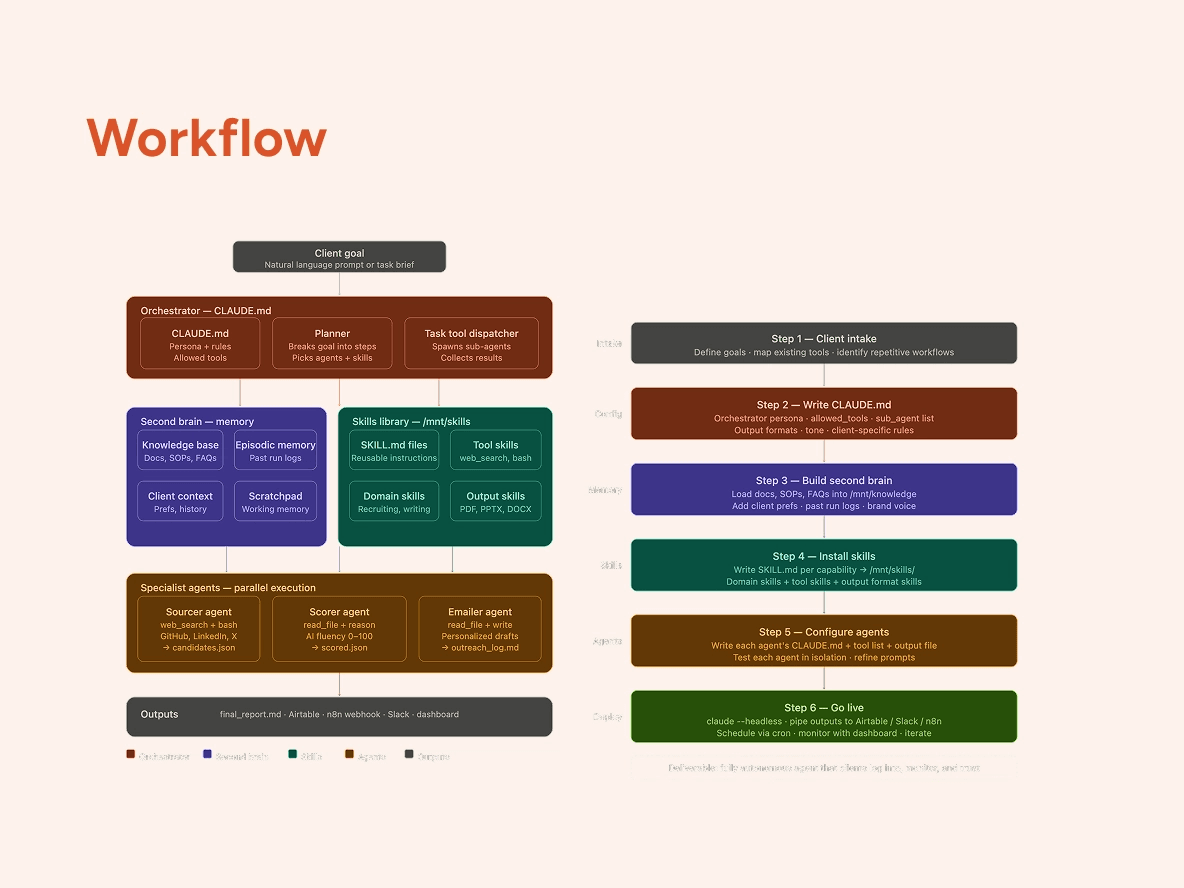
We are going to build you this system.
Scattered today: calls, docs, SOPs, CRM, decks, inboxes, people's heads
↓
The foundation: business context, brand rules, offers, client spaces, standards
↓
AI doing real work: sales, marketing, delivery, research
↓
And it compounds, because the work writes back into the foundation
A folder of saved prompts is not this. The difference is structure, isolation per client, and rules an AI can actually follow.
Why it is hard
Why this is not a weekend of typing.
- •Getting the business out of people's heads, which is interviewing, not typing
- •Deciding what is canonical, so two copies never disagree
- •Structuring it so AI retrieves the right thing instead of everything
- •Isolating each client or account so nothing bleeds between them
- •Writing rules an AI can actually follow, which is not the same as writing a policy
- •Keeping it current after launch, or it dies in a fortnight
- •Choosing which workflow to switch on first, because the wrong one proves nothing
The part everyone underestimates is that most of this is interviewing, not software.
Typical numbers
What a normal engagement looks like.
Two to four weeks for most teams, depending on how much is already written down and how fast we can get time with your people.
One to three workflows live at handover. After that, monthly, we add what is missing and cut what nobody uses.
What you get
Everything that gets built.
Your options
Why this makes sense.
Option one
Keep a folder of prompts
Free, and it is what almost everyone does. It does not compound, and it lives with one person who might leave.
Option two
Buy a platform
Fast, and your context lives in their database on their terms. You rent it, and you leave it behind if you leave.
Option three
Build it with me
Plain files you own, structured for your business, with someone doing the thinking about what belongs in it.
Timeline
How the build works.
- 1Call: where the repeated work is, and where AI already disappoints you
- 2Audit and architecture agreed
- 3Interviews, so the business comes out of people's heads
- 4The foundation written
- 5One to three workflows switched on
- 6Team walkthrough, everyone runs it once
- 7Monthly: add, cut, sharpen
What this costs
It depends on how many people use it.
And on how much you want switched on at handover. Most engagements start with a paid look at your business, so you see the work before the bigger decision.
One fixed number after the first call.
At the end
What you will have at the end.
Your business written down where your AI reads it. A separate space per client. Your standards captured. One to three jobs running. A roadmap for the next three months. And all of it in files you own, that keep working whether or not we work together.
Questions
Questions I get on calls
Is this just Notion?+
No. Notion is where people read. This is where your AI reads, and it loads before it answers anything. If you use Notion, it stays.
Do I own it?+
Yes. Plain files, your accounts, your version history.
Which AI tool do I need?+
It works with Claude, ChatGPT and the coding tools. If you already pay for seats, this is what makes those seats worth paying for.
We already have a wiki nobody opens.+
That is the normal starting point. A wiki is written for humans who might read it. This is written for the tool that reads it every single time.
Will my team actually use it?+
They use it through the work, not as a separate habit. The workflows we switch on are things they already do every week.
What about our client data?+
Separate spaces per client, access controls, and we agree what never goes in before we start.